Loading...
Searching...
No Matches
libscratchcpp::Block Class Reference
The Block class represents a Scratch block. More...
#include <scratchcpp/block.h>
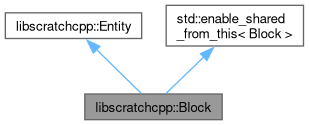
Inheritance diagram for libscratchcpp::Block:
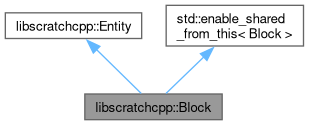
Collaboration diagram for libscratchcpp::Block:
Public Member Functions | |
| Block (const std::string &id, const std::string &opcode, bool isMonitorBlock=false) | |
| Block (const Block &)=delete | |
| CompilerValue * | compile (Compiler *compiler) |
| const std::string & | opcode () const |
| Block * | next () const |
| const std::string & | nextId () const |
| void | setNext (Block *block) |
| void | setNextId (const std::string &nextId) |
| Block * | parent () const |
| const std::string & | parentId () const |
| void | setParent (Block *block) |
| void | setParentId (const std::string &id) |
| const std::vector< std::shared_ptr< Input > > & | inputs () const |
| int | addInput (std::shared_ptr< Input > input) |
| std::shared_ptr< Input > | inputAt (int index) const |
| int | findInput (const std::string &inputName) const |
| const std::vector< std::shared_ptr< Field > > & | fields () const |
| int | addField (std::shared_ptr< Field > field) |
| std::shared_ptr< Field > | fieldAt (int index) const |
| int | findField (const std::string &fieldName) const |
| bool | shadow () const |
| void | setShadow (bool newShadow) |
| bool | topLevel () const |
| int | x () const |
| void | setX (int x) |
| int | y () const |
| void | setY (int y) |
| std::shared_ptr< Comment > | comment () const |
| const std::string & | commentId () const |
| void | setComment (std::shared_ptr< Comment > comment) |
| void | setCommentId (const std::string &commentId) |
| void | setEngine (IEngine *newEngine) |
| IEngine * | engine () const |
| void | setTarget (Target *newTarget) |
| Target * | target () const |
| BlockComp | compileFunction () const |
| void | setCompileFunction (BlockComp newCompileFunction) |
| HatPredicateCompileFunc | hatPredicateCompileFunction () const |
| void | setHatPredicateCompileFunction (HatPredicateCompileFunc newHatPredicateCompileFunction) |
| bool | mutationHasNext () const |
| void | setMutationHasNext (bool newMutationHasNext) |
| BlockPrototype * | mutationPrototype () |
| bool | isTopLevelReporter () const |
| void | setIsTopLevelReporter (bool isTopLevelReporter) |
| InputValue * | topLevelReporterInfo () |
| bool | isMonitorBlock () const |
| const std::string & | id () const |
| void | setId (const std::string &newId) |
Detailed Description
The Block class represents a Scratch block.
Constructor & Destructor Documentation
◆ Block() [1/2]
| Block::Block | ( | const std::string & | id, |
| const std::string & | opcode, | ||
| bool | isMonitorBlock = false ) |
Constructs Block
◆ Block() [2/2]
|
delete |
Member Function Documentation
◆ addField()
| int Block::addField | ( | std::shared_ptr< Field > | field | ) |
Adds a field and returns its index.
◆ addInput()
| int Block::addInput | ( | std::shared_ptr< Input > | input | ) |
Adds an input and returns its index.
◆ comment()
| std::shared_ptr< Comment > Block::comment | ( | ) | const |
Returns the comment which is attached to this block.
◆ commentId()
| const std::string & Block::commentId | ( | ) | const |
Returns the ID of the comment which is attached to this block.
◆ compile()
| CompilerValue * Block::compile | ( | Compiler * | compiler | ) |
Calls the compile function.
◆ compileFunction()
| BlockComp Block::compileFunction | ( | ) | const |
Returns the compile function.
- See also
- Block sections
◆ engine()
| IEngine * Block::engine | ( | ) | const |
Returns the Engine.
◆ fieldAt()
| std::shared_ptr< Field > Block::fieldAt | ( | int | index | ) | const |
Returns the field at index.
◆ fields()
| const std::vector< std::shared_ptr< Field > > & Block::fields | ( | ) | const |
Returns the list of fields.
◆ findField()
| int Block::findField | ( | const std::string & | fieldName | ) | const |
Returns the index of the field with the given name.
◆ findInput()
| int Block::findInput | ( | const std::string & | inputName | ) | const |
Returns the index of the input with the given name.
◆ hatPredicateCompileFunction()
| HatPredicateCompileFunc Block::hatPredicateCompileFunction | ( | ) | const |
Returns the edge-activated hat predicate compile function.
- See also
- Block sections
◆ id()
|
inherited |
Returns the ID.
◆ inputAt()
| std::shared_ptr< Input > Block::inputAt | ( | int | index | ) | const |
Returns the input at index.
◆ inputs()
| const std::vector< std::shared_ptr< Input > > & Block::inputs | ( | ) | const |
Returns the list of inputs.
◆ isMonitorBlock()
| bool Block::isMonitorBlock | ( | ) | const |
Returns true if this block belongs to a monitor.
◆ isTopLevelReporter()
| bool Block::isTopLevelReporter | ( | ) | const |
Returns true if this is a top level reporter block for a variable or a list.
◆ mutationHasNext()
| bool Block::mutationHasNext | ( | ) | const |
Returns true if the block can have a block following it.
◆ mutationPrototype()
| BlockPrototype * Block::mutationPrototype | ( | ) |
Returns the block prototype (in custom block definition).
◆ next()
| Block * Block::next | ( | ) | const |
Returns the next block.
◆ nextId()
| const std::string & Block::nextId | ( | ) | const |
Returns the ID of the next block.
◆ opcode()
| const std::string & Block::opcode | ( | ) | const |
Returns the opcode.
◆ parent()
| Block * Block::parent | ( | ) | const |
Returns the parent block.
◆ parentId()
| const std::string & Block::parentId | ( | ) | const |
Returns the ID of the parent block.
◆ setComment()
| void Block::setComment | ( | std::shared_ptr< Comment > | comment | ) |
Sets the comment which is attached to this block.
◆ setCommentId()
| void Block::setCommentId | ( | const std::string & | commentId | ) |
Sets the ID of the comment which is attached to this block.
◆ setCompileFunction()
| void Block::setCompileFunction | ( | BlockComp | newCompileFunction | ) |
Sets the compile function.
- See also
- Block sections
◆ setEngine()
| void Block::setEngine | ( | IEngine * | newEngine | ) |
Sets the Engine.
◆ setHatPredicateCompileFunction()
| void Block::setHatPredicateCompileFunction | ( | HatPredicateCompileFunc | newHatPredicateCompileFunction | ) |
Sets the edge-activated hat predicate compile function.
- See also
- Block sections
◆ setId()
|
inherited |
Sets the ID.
◆ setIsTopLevelReporter()
| void Block::setIsTopLevelReporter | ( | bool | isTopLevelReporter | ) |
Sets whether this block is a top level reporter block for a variable or a list.
- Note
- Setting this to true will allow the use of topLevelReporterInfo().
◆ setMutationHasNext()
| void Block::setMutationHasNext | ( | bool | newMutationHasNext | ) |
Sets whether the block can have a block following it.
◆ setNext()
| void Block::setNext | ( | Block * | block | ) |
Sets the next block.
◆ setNextId()
| void Block::setNextId | ( | const std::string & | nextId | ) |
Sets the next block by ID.
◆ setParent()
| void Block::setParent | ( | Block * | block | ) |
Sets the parent block.
◆ setParentId()
| void Block::setParentId | ( | const std::string & | id | ) |
Sets the parent block by ID.
◆ setShadow()
| void Block::setShadow | ( | bool | newShadow | ) |
Toggles whether this block is a shadow block.
◆ setTarget()
◆ setX()
| void Block::setX | ( | int | x | ) |
Sets the X-coordinate of the block in the code area (only for top level blocks).
◆ setY()
| void Block::setY | ( | int | y | ) |
Sets the Y-coordinate of the block in the code area (only for top level blocks).
◆ shadow()
| bool Block::shadow | ( | ) | const |
Returns true if this is a shadow block.
◆ target()
◆ topLevel()
| bool Block::topLevel | ( | ) | const |
Returns true if this is a top level block.
◆ topLevelReporterInfo()
| InputValue * Block::topLevelReporterInfo | ( | ) |
Returns the information about this top level reporter block (if this is a top level reporter block).
- Note
- This function will return nullptr if this isn't a top level reporter block. Use setIsTopLevelReporter(true) before using this function.
◆ x()
| int Block::x | ( | ) | const |
Returns the X-coordinate of the block in the code area (only for top level blocks).
◆ y()
| int Block::y | ( | ) | const |
Returns the Y-coordinate of the block in the code area (only for top level blocks).
The documentation for this class was generated from the following files: